
Fit is one of the most critical aspects of activewear. It impacts comfort, performance, and customer satisfaction. Poor fit is a leading reason for apparel returns, with 17% of returns tied to fit issues and 30% due to unmet expectations. To address these challenges, brands use a combination of physical and digital testing methods to ensure garments perform well during movement, maintain their shape, and meet customer expectations.
Here are the five most common methods for testing activewear fit:
- Human Fit Models: Provide real-world feedback on comfort, movement, and usability. They can detect small flaws but are expensive and time-consuming.
- Mannequin Fitting: Offers consistent and precise measurements for basic checks but lacks dynamic and comfort feedback.
- 3D Body Scanning: Quickly captures detailed measurements and creates virtual replicas for design adjustments. However, it struggles to simulate soft tissue behavior.
- Stretch and Recovery Testing: Evaluates fabric elasticity and durability under stress to ensure garments retain their shape and support.
- Dimensional Stability Testing: Assesses how garments hold up after washing and repeated use to prevent shrinkage or deformation.
Each method serves a unique purpose, and combining them ensures activewear meets high standards for fit, comfort, and durability.
Performance Vs Relaxed Fit: The Ultimate Sportswear Fitting Tutorial
sbb-itb-8dbc09a
1. Wear Testing on Human Fit Models
Wear testing with human fit models plays a crucial role in the development of activewear. During product development, most garments are tested by human models multiple times to identify and address potential issues before production begins. Professional fit models typically test anywhere from 8 to 20 garments in a single session, acting as the first line of feedback to improve garment design and functionality. These tests focus on several critical aspects of garment performance.
Real-world performance feedback
Human fit models provide insights that go beyond what digital simulations can reveal. By performing specific movements – like a "hug test" for jackets or walking in workout leggings – models help assess how garments perform in real-world scenarios. They also test functional details, such as placing a phone in a pocket, to ensure that features like zippers and pocket sizes are practical.
Fit models also evaluate fabric comfort and seam behavior through tactile feedback. As professional fit model Olivia described:
"I am like a regular customer who just goes in and like ‘How does this work?’ So, if I’m back in the fitting room for 10 minutes, and like ‘I don’t know how to put this on!’… I give that feedback".
This hands-on feedback helps brands catch design flaws early, leading to better-quality garments for consumers.
Consistency and repeatability
Consistency is just as important as performance feedback. Fit models maintain stable body measurements and postures across sessions, ensuring that tests remain consistent. They are chosen to represent the average customer, making their feedback relevant to a broad audience. Experienced models are so attuned to garment fit that they can detect minute discrepancies – sometimes as small as an eighth of an inch – simply by wearing the clothing.
"I remember working with one of my last clients and you know, tried the garment on and I said you know, I think this is like an eighth of an inch off. Because did you check the specs on it? And they look at the paper and they go ‘oh my god’." – Ava, Professional Fit Model
This level of precision ensures that garments meet consistent fit standards across production runs.
Fabric elasticity and recovery
Human testing is indispensable for evaluating how fabrics stretch, recover, and retain their shape during movement. Fit models perform dynamic tests to uncover issues that might only appear during activity, such as wrinkles, excessive fabric tension, or stitches that feel too tight or roll inward. These are challenges that current 3D simulations struggle to address, particularly when it comes to mimicking the "compressibility and elastic limit of human skin", which affects how elastic garments fit and feel. By identifying these issues early, manufacturers can resolve fabric recovery problems, ensuring that garments retain their shape and support throughout their use.
2. Mannequin Fitting
Mannequin fitting provides a standardized method for testing activewear by eliminating the inconsistencies that come with human models. While fit models may have slight measurement variations between sessions, mannequins maintain fixed anthropometric dimensions and consistent posture for every test. This creates a controlled environment where manufacturers can gather repeatable and reliable measurements, ensuring quality assurance. Though human models offer dynamic feedback, mannequins bring unmatched precision to technical evaluations.
Consistency and Repeatability
The biggest strength of mannequin fitting lies in its consistency. Acting as an unchanging standard, mannequins streamline the testing process. Studies comparing 3D anthropometric systems have shown that mannequins consistently deliver the most accurate and repeatable girth measurements.
Precision of Measurements
Mannequin fitting also allows designers to see how 2D fabric properties translate into a 3D garment. Automated 3D scanning of mannequins provides highly accurate girth, arc, and linear measurements, far surpassing the reliability of manual methods. This level of precision is especially critical for activewear, where even minor dimensional differences can impact compression and overall performance. As ScienceDirect explains:
"In these cases fabric or material testing does not provide accurate and reliable information of the final garment, as there are many factors that affect the final results, such as clothing design, fit, shape, layering, and coverage of body surface, which are not considered in material or fabric testing."
Shape Retention and Durability
Mannequins are particularly effective for evaluating structural aspects like fit, shape, and body surface coverage – areas that fabric-only testing cannot address. Digital mannequins can measure tension and strain, and recent predictive models have achieved up to 93% accuracy in classifying garment fit as "tight", "fit", or "loose", outperforming traditional manual methods. These precise measurements complement wear testing by verifying the garment’s structural integrity. However, mannequins fall short when it comes to providing qualitative insights, such as how comfortable a fabric feels or whether it causes skin irritation – feedback that only human models can provide.
3D Body Scanning
3D body scanning takes the precision of mannequin fitting to a whole new level by using advanced digital tools to create highly accurate virtual replicas of the human body. This technology captures detailed anthropometric data in just seconds. Stationary scanners can complete their work in as little as 5–20 seconds, while mobile systems might take slightly longer, ranging from 30 seconds to 5 minutes. What sets this method apart is its ability to measure data like surface area, body volume, and even body fat percentage – details that manual methods simply can’t provide.
Precision of Measurements
The accuracy of 3D body scanning has been rigorously tested and validated against international standards. For instance, a study on photogrammetric systems revealed that 57 out of 59 measurement items met the stringent ISO 20685-1:2018 criteria. Researchers Ryu, Zhang, and Song highlighted the strengths of this technique, stating:
"The photogrammetric technique was found to have the advantage of scanning the top of the head, armpit, and crotch areas clearly."
This level of detail is especially critical for activewear, such as sports bras and leggings, where precise fits in areas like the armpits and crotch significantly impact comfort and performance. Moreover, AI-powered mobile applications now enhance this process by pinpointing landmarking points to deliver exact measurements for product development and sizing. Compared to stationary scanners, photogrammetry also reduces errors caused by breathing or small movements, making it a more reliable option.
Consistency and Repeatability
One of the greatest strengths of 3D body scanning is its ability to eliminate the inconsistencies of manual measurements. Automated scanning ensures precise data collection, which integrates seamlessly with CAD tools. For example, 20 out of 32 dimensions (62.5%) captured by the Vitus Bodyscan system were found to align with ISO standards, offering reliable measurements that are particularly beneficial for activewear. Adding color markers before scanning further improves accuracy by reducing errors in landmark placement.
Once the scans are complete, digital avatars can be imported into CAD software like CLO3D or V-Stitcher. These tools can generate pressure and tension maps, providing a clear visualization of how garments fit across different body types. This process allows designers to identify potential fit issues early, complementing physical testing before moving to human evaluations.
That said, 3D scanning does have its limits. While it excels at capturing static body shapes, it struggles to replicate how soft tissue deforms under tight, stretchy fabrics. Because of this, human model evaluations remain a critical step in the development process. Even with advanced scanning, over 90% of garments still undergo testing on live fit models two to three times to ensure they meet comfort and performance standards.
4. Stretch and Recovery Testing
Stretch and recovery testing examines how fabrics behave under stress. This process evaluates a fabric’s ability to stretch during movement and then return to its original shape. For activewear designed to endure rigorous workouts, this testing ensures that garments retain their fit over time.
Fabric Elasticity and Recovery
Elasticity refers to how much a fabric can stretch when force is applied, while recovery measures how well it returns to its original length once the force is removed. High elasticity is essential for items like leggings and sports bras, allowing them to move with your body during exercises like squats or sprints without feeling restrictive. However, poor recovery can lead to sagging and deformation, negatively affecting the garment’s performance.
Durability is assessed through the Permanent Deformation Rate, which tracks the amount of stretch a fabric cannot recover from. To simulate long-term wear, manufacturers often perform fatigue testing by stretching the fabric for 1,000 cycles at a set frequency. This process checks for structural damage or loss of tension, which is especially critical for compression garments that need to maintain consistent pressure to perform effectively.
Precision of Measurements
Modern tools like CLO 3D provide detailed insights into fabric behavior by generating stress and strain maps. Stress maps highlight pressure zones that could lead to fit issues, while strain maps measure distortion levels – where 120% indicates high distortion and 100% represents no distortion.
In June 2023, researchers at Ghent University and Bahir Dar University used CLO 3D to improve the design of a cycling shirt. They tested a stretch fabric blend (68% viscose, 27% nylon, 5% elastane) against 100% cotton. The initial design caused excessive pressure – up to 70.5 Virtual kPa – on the front panel. By analyzing stress maps and adjusting the side seams and neckline, they reduced these pressure points, achieving a more balanced compression fit tailored for professional cycling. This example shows how precise tools can address fit issues before physical production even begins.
Such detailed analysis also plays a role in assessing garment durability under dynamic conditions.
Shape Retention and Durability
Beyond the material’s properties, maintaining shape during movement is essential for activewear performance. Devices like the MODY tester replicate real-world movements to objectively measure support and fit. As Hohenstein explains:
"Testing the support of sports bras provides objective and reproducible results, without human influence."
This data-driven approach allows brands to validate claims like "high support" with measurable results instead of relying solely on subjective feedback. Testing garments in sport-specific poses is key, as pressure distribution can vary significantly with movement. For example, a cycling shirt might fit well while standing but could cause uncomfortable pressure at the collar when the wearer leans forward into a cycling position.
5. Dimensional Stability Testing
Dimensional stability testing evaluates whether a garment keeps its original size and shape after repeated washing, heating, or wearing. For activewear, this means ensuring your leggings don’t shrink in the dryer or your sports bra doesn’t stretch out after a few workouts. The focus here is on size conformity – making sure the fit stays consistent from the first wear to many uses down the line. To achieve this, precise and repeatable testing protocols are critical.
Consistency and Repeatability
Standardized testing methods like ISO 6330, AATCC 135, and spirality testing (AATCC 179) are used to assess how fabrics and seams handle repeated laundering and heat exposure. These protocols ensure that every production batch meets the same specifications, which is vital when producing thousands of units with a professional custom leggings manufacturer. For example, spirality testing checks if garments twist after washing – a common problem that can distort the fit of activewear. This test confirms that seams stay within acceptable tolerances, ensuring the garment performs as intended across multiple washes. By addressing these potential issues, dimensional stability testing guarantees that garments maintain their original specifications throughout their lifespan.
Precision of Measurements
Even the smallest deviations in fit can be detected by professional fit models, who rely on their tactile sensitivity to identify discrepancies as small as one-eighth of an inch. Fit model Ava shared her experience:
"I think this is like an eighth of an inch off. Because did you check the specs on it? And they look at the paper and they go ‘oh my god’. So, I was really proud that I just had this very tactile ability."
In addition to human feedback, mechanical testing devices like the MODY tester provide objective data on how garments respond to movement. Hohenstein highlights this approach:
"Testing the support of sports bras provides objective and reproducible results, without human influence."
Combining human expertise with mechanical testing ensures that dimensional stability claims are accurate and consistent across production batches.
Shape Retention and Durability
Maintaining a garment’s shape is essential for its long-term performance. Dimensional stability testing complements earlier wear and mechanical tests by verifying the garment’s structural integrity over time. Stability directly affects a garment’s set – how smoothly it fits the body without wrinkles or fabric tension. If stability is lacking, the fabric grainline may shift, leading to twisting or pulling during wear. Rigorous testing minimizes these distortions, ensuring the garment retains its intended fit after washing.
This testing also extends the product’s lifespan, which has broader environmental benefits. Textile production contributes more to climate change than aviation and shipping combined, making durability an important factor. When activewear maintains its shape and size over time, it reduces the need for frequent replacements – saving resources and benefiting both consumers and the planet.
Comparison Table
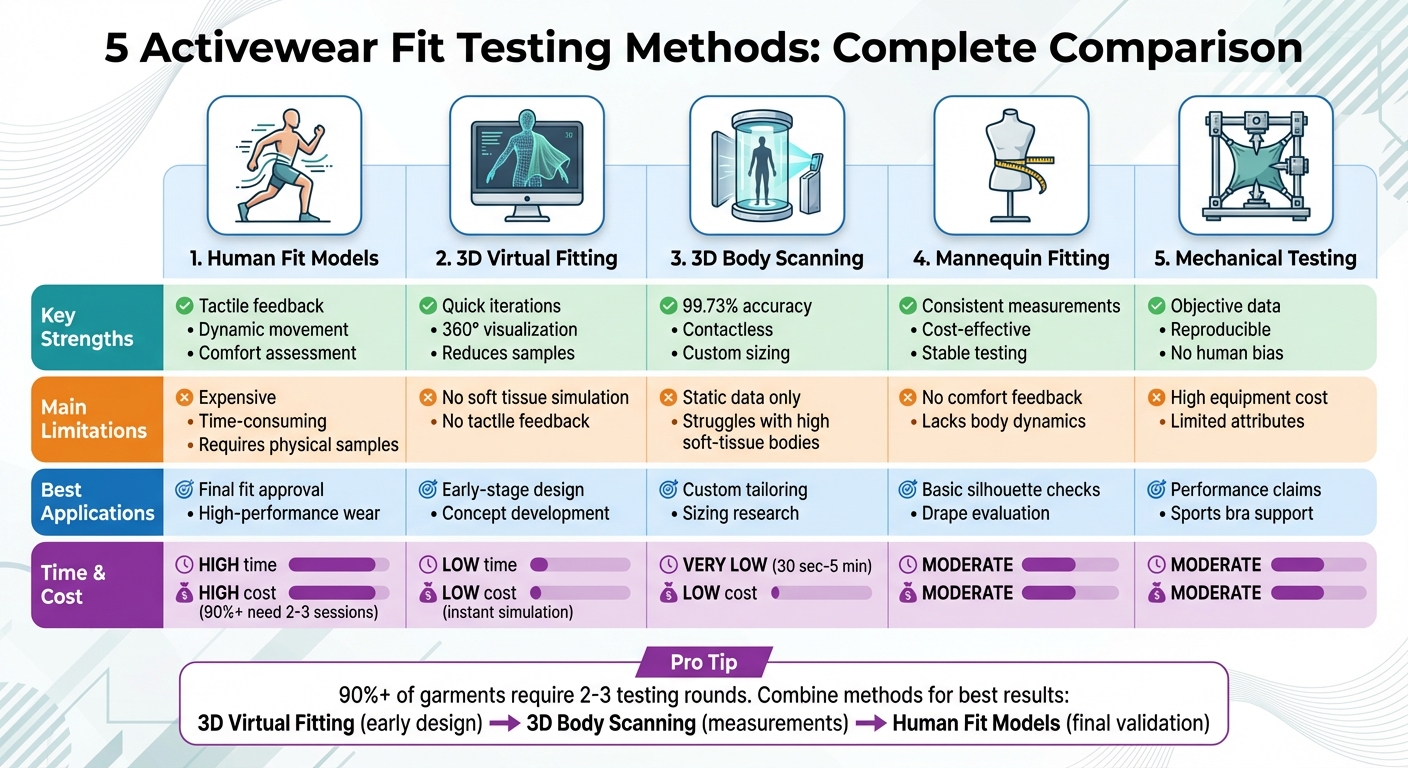
Comparison of 5 Activewear Fit Testing Methods: Strengths, Costs, and Applications
Each testing method offers distinct benefits and drawbacks, helping determine the best approach for activewear development.
The table below highlights key strengths, limitations, and ideal applications for each method. Human fit models remain the standard for final approval due to their ability to provide tactile feedback and assess dynamic movement. However, they come with high costs and require multiple sessions, as over 90% of garments need two to three fittings during development. 3D virtual fitting speeds up early design by allowing quick iterations without physical samples, though it falls short in replicating how soft tissue behaves. Meanwhile, 3D body scanning delivers highly precise measurements (99.73% confidence for 49% of common body dimensions), making it a go-to for custom sizing and tailoring. Mannequin fitting is a budget-friendly option for basic visual checks but offers no insight into comfort or movement. Lastly, mechanical testing devices like the MODY tester provide objective, reproducible data, particularly valuable for sports bras, though the equipment is expensive.
| Method | Strengths | Limitations | Best For | Time Requirement | Cost Level |
|---|---|---|---|---|---|
| Human Fit Models | Provides tactile and comfort feedback; identifies usability issues; evaluates dynamic movement | Expensive; time-consuming; subjective; requires physical prototypes | Final fit approval and high-performance activewear | High (multiple sessions) | High (model fees, travel, samples) |
| 3D Virtual Fitting | Enables quick iterations; reduces sample production; offers 360° visualization and tension mapping | Cannot simulate soft tissue compressibility; no tactile feedback | Early-stage design and concept development | Low (instant simulation) | Low (cuts physical sample costs) |
| 3D Body Scanning | Highly accurate measurements; contactless; supports air-gap analysis | Struggles with muscular or high-soft-tissue bodies; only captures static data | Custom tailoring and sizing research | Very low (30 seconds to 5 minutes) | Low (long-term savings) |
| Mannequin Fitting | Stable and consistent for visual checks; cost-effective | No comfort or movement feedback; lacks real-world body dynamics | Basic silhouette and drape checks | Moderate | Moderate |
| Mechanical Testing | Produces objective, reproducible data; eliminates human bias; offers precise performance metrics | Limited to specific attributes; high equipment cost | Verifying performance claims (e.g., "high impact" support) | Moderate (standardized) | Moderate (equipment cost) |
A well-rounded approach can improve both efficiency and accuracy. For instance, 3D virtual fitting is ideal for early design phases, while human fit models are crucial for final validation. For sports bras, combining mechanical testing with live evaluations ensures comprehensive performance testing. This breakdown highlights the importance of using a balanced testing strategy throughout the development process.
Conclusion
Creating high-performance activewear demands a thorough, multi-step approach to fit testing at every stage of development. The five methods discussed here work together to ensure garments can handle the realities of athletic movement. For instance, 3D body scanning and virtual fitting streamline the early design process, cutting down on the need for excessive physical samples. Meanwhile, human fit models provide critical tactile feedback and insights on comfort – elements that digital tools alone can’t fully capture. Additionally, stretch and recovery testing ensures fabrics perform as needed, and dimensional stability testing guarantees garments maintain their shape after regular use and washing.
Fit testing is an iterative process, with over 90% of garments undergoing two to three rounds of adjustments to resolve inconsistencies before production begins. Professional fit models play a key role here, spotting even the smallest flaws that could affect how the garment performs. This attention to detail is what separates average activewear from pieces that perform exceptionally under athletic stress. At New Dong Huang Garment Co., Ltd., this rigorous process is backed by decades of expertise, ensuring superior design and functionality.
By combining these proven testing methods, New Dong Huang Garment Co., Ltd. leverages 27 years of experience to produce activewear that meets the highest global fit standards. Whether it’s sustainable compression leggings or high-impact sports bras, their approach blends digital tools with hands-on testing to deliver garments that offer the support, comfort, and durability athletes require. This comprehensive strategy not only validates performance claims but also reduces return rates and speeds up the launch of new collections.
Looking to the future, the balance between digital innovation and human expertise will continue to shape activewear development. As Professor Hein Daanen noted, "The future of successful smart garments is intertwined with the success of virtual fitting technique". However, human validation remains crucial – particularly as activewear integrates more sensors and smart technologies that rely on precise, consistent fits to work effectively. A well-rounded testing process, combining digital advancements with hands-on evaluation, remains the cornerstone of activewear that truly delivers.
FAQs
Which fit test should be done first?
The first step in assessing a garment’s fit should be a physical fitting. This process involves checking the garment’s measurements and how it fits on an actual model or prototype. By doing this early on, you can confirm that the design matches the intended specifications before moving on to virtual or more advanced testing methods.
How many fit rounds are usually needed?
Typically, it takes 2 to 3 fitting rounds to perfect the fit of a garment. These sessions are crucial to ensure the design, sizing, and comfort align with expectations before moving forward with final production.
Why can’t 3D fit replace human fit models?
3D fit technology has its perks, but it can’t completely take the place of human fit models. Why? It relies on line-of-sight technology, which struggles to detect areas that are hidden or blocked. This shortcoming makes it tough to capture the intricate three-dimensional shapes and subtle variations of the human body with complete accuracy.